


Outside South Africa’s urban centres—on farms, smallholdings, and remote sites—unstable internet is the norm. Users face frequent buffering, dropped connections, and inconsistent speeds. The underlying cause is rarely your data plan or ISP. The real constraint is signal acquisition failure.
Most consumer devices—phones and indoor routers—use low-gain antennas. These are poorly equipped to capture LTE signals over:
- Long distances
- Challenging terrain (hills, trees, buildings)
- Sparse cellular infrastructure
This results in poor connectivity and unreliable internet.
The MikroTik LHG LTE6 Kit addresses this exact challenge:
Capture weak LTE → stabilize it → deliver usable internet via Ethernet
This system performs exceptionally well—but only when:
- There is some LTE coverage nearby
- The device is mounted and aligned correctly outdoors
Remove either condition, and performance predictably deteriorates.
What Is the MikroTik LHG LTE6 Kit?
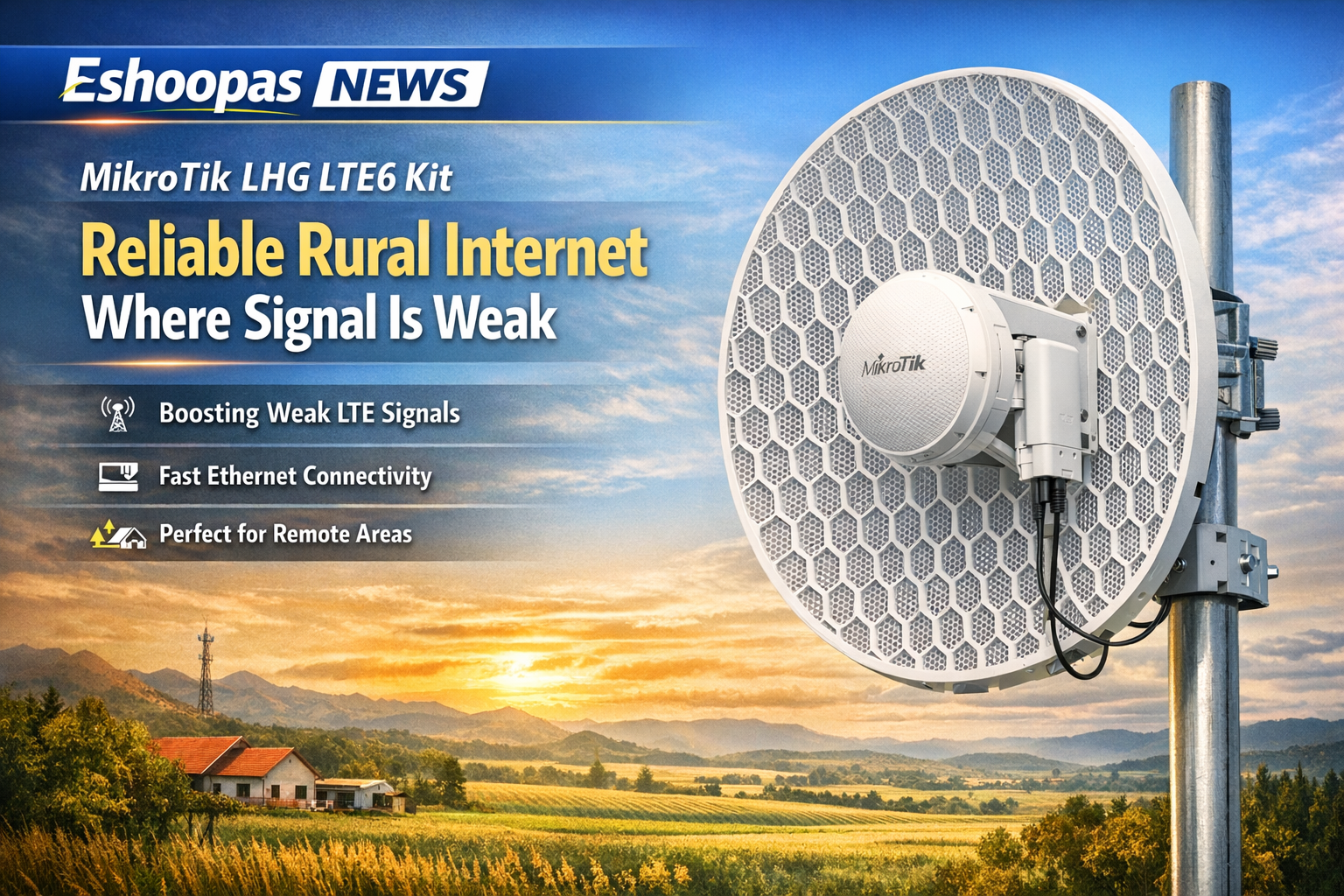
This is not a consumer WiFi router. It’s a directional outdoor LTE Customer Premises Equipment (CPE) designed to reliably capture weak LTE signals in rural settings.
Core Components
- A high-gain (~17 dBi) directional antenna
- LTE Category 6 modem supporting carrier aggregation
- Ethernet output for seamless integration with indoor networks
Functionality
- Locks onto distant LTE towers
- Stabilizes fluctuating or weak signals
- Provides consistent internet connectivity via Ethernet
Limitations
- Does not provide built-in WiFi (requires a separate indoor router)
- Does not create LTE coverage where none exists
Key Specifications That Matter
- LTE Category: Cat 6 with carrier aggregation
- Max Theoretical Speeds: 300 Mbps download / 50 Mbps upload
- Antenna Gain: ~17 dBi (the critical performance factor)
- Ethernet Port: 10/100 Mbps (real-world throughput cap)
- Power: Passive Power over Ethernet (PoE)
- Operating System: MikroTik RouterOS (advanced configuration interface)
Key takeaway: This device is designed for signal stability under challenging conditions, not just headline speeds.
South African Network Compatibility
Compatible with all major South African LTE networks:
- Vodacom
- MTN
- Telkom
Influencing Factors on Performance
- Distance to the nearest cell tower
- Physical terrain and obstructions (trees, hills, buildings)
- Network congestion and peak usage times
This device enhances signal quality and stability but does not expand network capacity.
Expected Real-World Performance
Typical speeds in rural South Africa:
- Weak LTE signal areas: 5–20 Mbps (stable)
- Moderate LTE coverage areas: 20–50 Mbps (usable)
- Latency: Low, significantly better than satellite, which is critical for real-time applications
Ideal Use Cases
- Remote CCTV and security system connectivity
- Video conferencing and online communication (Zoom, Teams, WhatsApp)
- Farm IoT and cloud-based monitoring
- General internet browsing and media streaming
Installation: The Most Important Factor for Success
Most subpar user experiences stem from improper installation rather than device failure.
Installation Requirements
- Mount the device outdoors on a roof, pole, or mast
- Elevate as high as possible for unobstructed line-of-sight
- Ensure the antenna points directly toward the nearest LTE tower
Setup Process
- Securely mount the device outdoors.
- Connect power and data via the included PoE injector (single cable).
- Access the device’s RouterOS interface through a web browser.
- Configure the APN settings based on your SIM provider.
- Precisely align the antenna toward the tower.
- Update to the latest firmware for optimal performance.
Critical Insight
A misalignment of even 10–20 degrees can reduce signal strength and speeds by more than 50%. Precise alignment is not optional—it is fundamental.
Limitations: What You Must Know
This device will underperform or fail if:
- No LTE coverage exists in your area.
- It is installed indoors or behind obstructions.
- You expect it will magically create coverage or provide WiFi without additional equipment.
How to Mitigate
- Increase mounting height and reposition as needed.
- Test SIM cards from different providers to find the strongest local network.
- Use a reliable indoor WiFi router to distribute internet wirelessly.
LTE vs Satellite vs Indoor LTE Routers: How the LHG LTE6 Stacks Up
| Feature | MikroTik LHG LTE6 Kit | Satellite Internet | Indoor LTE Router |
|---|---|---|---|
| Latency | Low | Very high | Medium |
| Weather Impact | Low | High | Medium |
| Signal Reception | High-gain directional | Omnidirectional | Low-gain indoor |
| Weak Area Reliability | High (with proper setup) | Variable | Poor |
If LTE coverage is available at all, the MikroTik LHG LTE6 Kit offers the best return on investment for rural connectivity.
Who Should Invest in the MikroTik LHG LTE6 Kit?
- Rural homeowners struggling with weak LTE
- Farmers requiring reliable IoT and automated system connectivity
- Security installations needing stable remote CCTV access
- Construction sites and remote operations requiring dependable mobile internet
Who Should Avoid This Device?
- Urban fibre users with strong broadband options
- Areas without any LTE coverage
- Those expecting simple plug-and-play, built-in WiFi devices
Pricing and How to Buy
The MikroTik LHG LTE6 Kit is competitively priced around R3,200 in South Africa.
Ready to resolve your rural internet issues?
Purchase the MikroTik LHG LTE6 Kit now on Eshoopas
Troubleshooting Guide
Weak Signal?
- Raise the mounting height.
- Clear obstacles from the signal path.
- Re-align antenna accurately.
Slow Speeds?
- Check for network congestion.
- Reduce number of devices sharing the connection.
- Try SIM cards from alternate providers.
Connection Drops?
- Update the device firmware.
- Inspect PoE injector and cabling.
- Restart the device and indoor router regularly.
Final Assessment
The MikroTik LHG LTE6 Kit is a focused, high-performance tool engineered to resolve weak LTE signal issues in rural South Africa.
- With existing LTE coverage and proper installation, it delivers stable, reliable internet far superior to standard routers.
- Without LTE coverage or correct setup, it will fail to meet expectations.
This device does one job and does it well: turn weak LTE into consistent connectivity.
Frequently Asked Questions (FAQ)
Does the MikroTik LHG LTE6 Kit provide WiFi?
No. It outputs internet via Ethernet only. A separate indoor WiFi router is required.
How far can the LHG LTE6 Kit reach?
It can capture signal from several kilometres away, depending on line-of-sight and terrain.
Is setup difficult?
Basic setup is straightforward, but optimal antenna alignment requires patience and precision.
Which network provider works best in rural South Africa?
Vodacom and MTN generally offer the strongest rural coverage, but local testing is essential.
Take control of your rural internet today with the MikroTik LHG LTE6 Kit.Don’t settle for unstable or slow connections.
Order now from Eshoopas and experience reliable LTE internet anywhere in South Africa.
No Comment Found.